
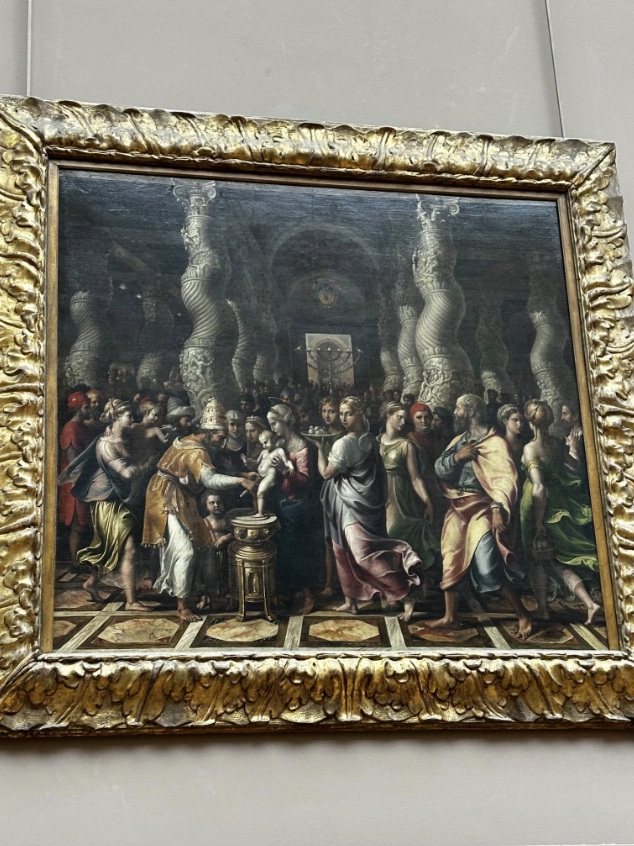
Giulio Romano, The Circumcision, c. 1524. Louvre Museum, Paris.
Several years ago, one of my daughters was visiting the Louvre in Paris when she came across a painting that immediately made her think of me. She took a photograph and sent it to me: a Renaissance depiction of the circumcision of Jesus.
The painting, The Circumcision, is attributed to Giulio Pippi, known as Giulio Romano, and dates to about 1524.¹ The museum label describes the infant Jesus being circumcised in the Temple on the eighth day after his birth. Seeing circumcision represented so prominently in Renaissance religious art is a reminder that this procedure has occupied a remarkable place in human history: in medicine, religion, ritual, identity, art, and culture.
That photograph captures what I find most interesting about the history of circumcision: the practice is far older and more culturally diverse than many of us realize. Its story begins before written history, appears unmistakably in ancient Egypt, becomes central to the covenant of Judaism, is carried into the story of Jesus and early Christianity, becomes deeply established across the Islamic world, and appears in traditional cultures across Africa, Asia, and the Pacific.
To understand how a practice represented in Renaissance Christian art came to span so many civilizations, we have to begin much earlier: before Egypt, before Abraham, and before recorded history.
A practice older than recorded history
Male circumcision is often discussed today as a medical procedure or as a practice associated primarily with Judaism and Islam. Its history, however, is far older and considerably broader. Evidence of circumcision appears before written history. Ancient Egypt provides the earliest widely recognized visual evidence of the procedure. Circumcision later became central to Judaism, was encountered and debated by early Christianity, became deeply embedded in Islamic culture, and developed as an important rite of passage in numerous African and other societies.
Today, circumcision crosses religious, geographic, and cultural boundaries. Estimates suggest that approximately 37–39% of males worldwide are circumcised, although prevalence varies enormously among countries and communities.²
Understanding this history helps explain an important point: circumcision belongs to many religions, cultures, and periods of human history.
Before written history: circumcision in Paleolithic art
The origins of circumcision are unknown because the practice appears to extend beyond the beginning of recorded history.
Researchers Javier Angulo and Marcos García-Díez examined male genital representations in European Upper Paleolithic art. Their work describes representations that may indicate deliberate foreskin retraction or circumcision and raises the possibility of a culture involving preputial retraction or circumcision during the Paleolithic period.³˒⁴
The interpretation requires caution. A prehistoric image cannot tell us whether foreskin retraction was temporary, ritualized, or the result of circumcision. Nevertheless, the evidence suggests that humans were depicting and modifying male genital anatomy long before the civilizations and religions with which circumcision would later become associated. Other Paleolithic artifacts appear to depict genital scarification, piercing, and tattooing.⁴
Circumcision may therefore belong to a much older human tradition of body modification, ritual, identity, sexuality, and passage from one stage of life to another.
Ancient Egypt: the first clear visual record
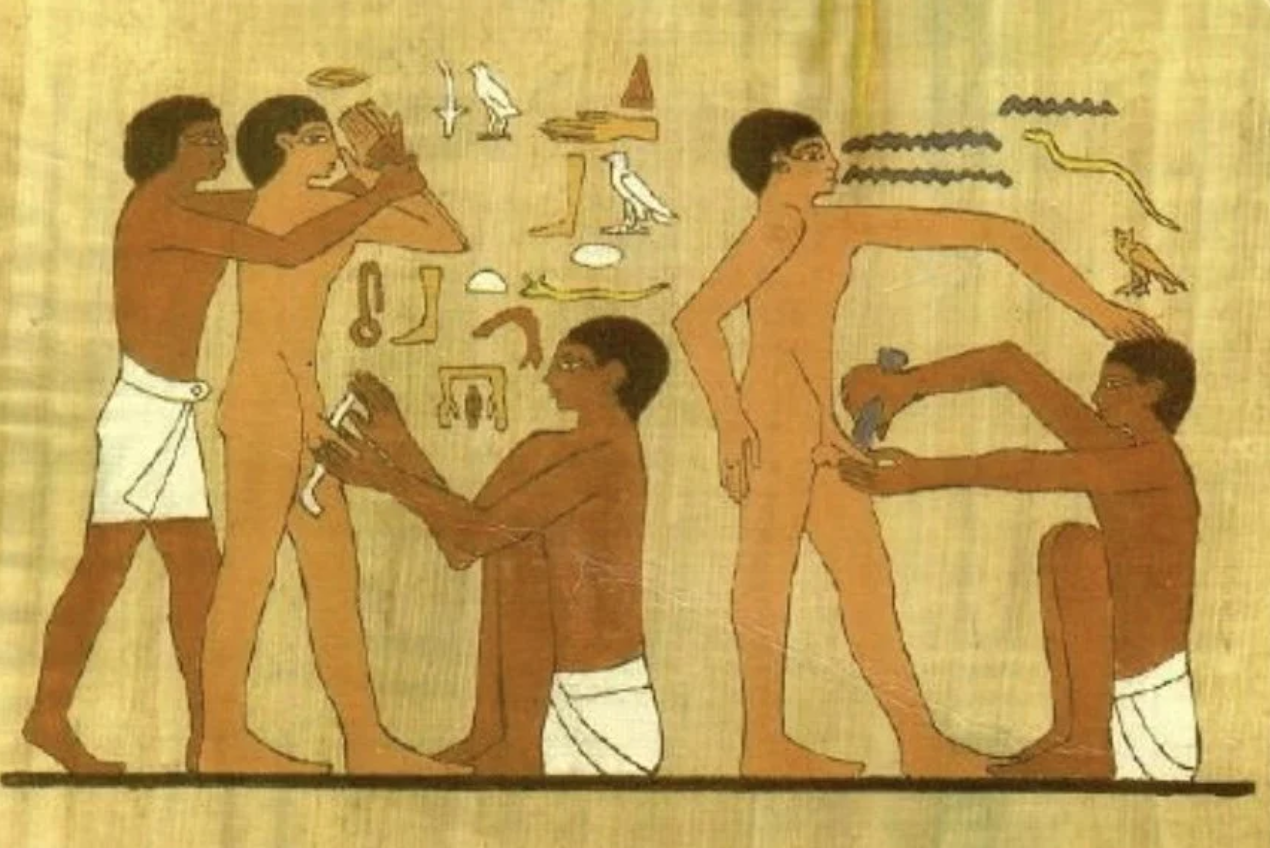
Circumcision scene from the tomb of Ankhmahor, Saqqara, Egypt, c. 2300 BCE (modern reproduction).
With ancient Egypt, the evidence becomes much clearer.
A famous relief from the tomb of Ankhmahor at Saqqara, dating to approximately the 24th century BCE, depicts what is widely interpreted as circumcision being performed. Historical reviews describe an Egyptian representation dating to roughly 2300 BCE as the oldest known image clearly depicting the procedure.⁵
The significance of Egypt extends beyond a single image. Historical scholarship places circumcision within ancient Egyptian society centuries before the biblical period.⁶˒⁷ This chronology matters: circumcision existed before Judaism, Christianity, and Islam.
The nineteenth-century physician Peter Charles Remondino recognized the extraordinary antiquity and geographic breadth of the practice in his 1891 book, History of Circumcision from the Earliest Times to the Present. Some of Remondino's medical theories reflect nineteenth-century medicine and should not be treated as contemporary evidence, but his book remains an important historical source.⁸
Judaism: circumcision as covenant
No major religious tradition is more closely identified with circumcision than Judaism.
In Genesis 17, circumcision becomes the physical sign of the covenant between Abraham and God.⁹ Jewish tradition developed this into brit milah, with circumcision traditionally performed on the eighth day of a male infant's life.⁹
Over centuries, circumcision became a visible and enduring expression of covenant, religious identity, continuity, and membership in the Jewish people. Historical scholarship traces changes in both the meaning and ceremony of Jewish circumcision from biblical antiquity through later Jewish practice.¹⁰˒¹¹
Christianity: a different relationship with circumcision
Christianity presents a particularly interesting chapter in this history.
Jesus was Jewish and was circumcised.¹² The early Christian movement emerged from Judaism, and circumcision therefore became one of the fundamental questions facing the developing Christian church: would non-Jewish converts also need to be circumcised?¹²
The answer was ultimately no. Early Christianity separated membership in the Christian faith from the physical requirement of circumcision. Historical reviews note that, despite the circumcision of Jesus and Christianity's Jewish origins, circumcision did not become a required Christian religious rite.⁵
That distinction is important when discussing Catholicism. Circumcision among Catholic and other Christian populations is better understood through local culture, medicine, family tradition, and geography.
The Philippines: circumcision in a predominantly Catholic culture
The Philippines demonstrates how circumcision can become deeply embedded in a society independently of formal religious requirement.
The country is predominantly Christian and largely Catholic, yet circumcision, commonly known as tuli, has long functioned as a culturally important transition from boyhood toward manhood. Research on Filipino circumcision describes strong connections between the practice, masculinity, male identity, and community expectations.¹³˒¹⁴
It is commonly performed later in childhood, often just before adolescence, and literature on the Philippines describes it primarily as a rite of passage.¹⁵
The Philippines is therefore an important reminder that a population's religion and the cultural meaning of circumcision can differ.
Islam: a practice shared across an enormous geographic area
Circumcision is also deeply associated with Islam.
Circumcision is not explicitly commanded in the Qur'an. Its religious importance developed through Islamic tradition and the example of Abraham, whom Muslims recognize as a prophet.⁵˒⁷
Islamic tradition prescribes no single universal age for circumcision. Depending upon the country and community, circumcision may occur during infancy, childhood, or before puberty.¹⁶
Its geographic reach is extraordinary. Circumcision is prevalent across much of North Africa, the Middle East, and many Muslim populations throughout Asia and Africa. Religion is one of the strongest population-level correlates of circumcision, although practice varies by country and community.²˒¹⁷
Africa: religion, identity, initiation, and manhood
Africa shows especially clearly how many meanings circumcision can carry beyond religion.
In North and parts of West Africa, high circumcision prevalence is strongly associated with religious and cultural traditions. In parts of Eastern and Southern Africa, circumcision has historically functioned as an initiation ritual and transition from boyhood to manhood.¹⁸
Among the Xhosa of South Africa, for example, traditional male circumcision is part of a broader and deeply significant initiation process associated with the transition to manhood.¹⁹ Studies of other South African communities likewise describe circumcision as a rite of passage intertwined with concepts of masculinity and adult social status.²⁰
Modern medicine has added another layer. Voluntary medical male circumcision programs for HIV prevention now coexist with much older religious and traditional practices. Research repeatedly shows that successful programs must account for local religion, ethnicity, cultural expectations, and the meanings communities attach to circumcision.¹⁷˒²¹˒²²
Asia and the Pacific: circumcision beyond the Middle East
Circumcision is also deeply established in portions of Asia and the Pacific.
Indonesia, Pakistan, Bangladesh, Malaysia, and other countries contain large Muslim populations in which circumcision is common. The Philippines provides a striking predominantly Christian example. Cultural circumcision and coming-of-age practices have also been described in Pacific Island populations.²
The geographic breadth of these traditions shows how many different civilizations and faiths have embraced circumcision.
From ancient ritual to modern medicine
Circumcision underwent another transformation in the nineteenth and twentieth centuries.
In Britain and later the United States, physicians increasingly performed circumcision for purported medical reasons. Some nineteenth-century indications were based on theories that medicine has long since abandoned. Over time, however, circumcision became incorporated into modern surgery and newborn care, particularly in the United States.⁶˒²³
Modern clinical research subsequently examined circumcision through a very different lens: surgical safety, urinary tract infection, sexually transmitted infections, HIV prevention, HPV, sexual function, and public health. The contemporary medical literature therefore represents another chapter in a practice whose history began long before modern medicine.²⁴˒²⁵
One procedure, many meanings
Looking across this history, circumcision tells many different stories.
For different peoples and at different times, circumcision has represented covenant with God, religious identity, ritual purity, transition to adulthood, masculinity, membership in a community, cultural continuity, family tradition, medical treatment, preventive health, or some combination of these.
Even its origins may not represent a single historical event. The broad geographic distribution of male genital modification has led historians and anthropologists to consider whether such practices arose independently in multiple human populations rather than spreading from one original culture. The evidence does not allow that question to be answered with certainty.⁴˒⁷
That uncertainty makes the Paleolithic evidence particularly intriguing. Circumcision may be part of a much older human tendency to use the body itself to express identity, belonging, transition, and meaning.
A practice that crosses religions and continents
Judaism made circumcision one of history's most recognizable signs of religious covenant. Islam carried a circumcision tradition across an enormous portion of Africa and Asia. Christianity did not require the practice, yet circumcision became deeply established among some Christian populations, most strikingly in the Philippines. African societies developed circumcision traditions connected to initiation, adulthood, ancestry, and community identity. Other forms appeared across Asia and the Pacific.
And all of this occurred after circumcision (or something remarkably similar to it) may already have appeared in human art thousands of years before written religion.
Circumcision is a human practice whose history crosses religions, civilizations, continents, and thousands of years.
References
Giulio Romano. The Circumcision, c. 1520–1524. Oil on canvas (transferred from panel), 115 × 122 cm. Musée du Louvre, Paris, INV 518. See: Sapir I. Circumcision/Circumnavigation. The Visual Commentary on Scripture. https://thevcs.org/campaign/circumcisioncircumnavigation
Morris BJ, Wamai RG, Henebeng EB, et al. Estimation of country-specific and global prevalence of male circumcision. Popul Health Metr. 2016;14:4. doi:10.1186/s12963-016-0073-5.
Angulo JC, García-Díez M. Male genital representation in Paleolithic art: erection and circumcision before history. Urology. 2009;74(1):10-14. doi:10.1016/j.urology.2009.01.010. See also: Angulo Cuesta J, García-Díez M. The meaning of erection, genitality, and other representations of urologic topics in the Paleolithic imaginary. Arch Esp Urol. 2007;60(8):845-858. doi:10.4321/S0004-06142007000800002.
Angulo JC, García-Díez M, Martínez M. Phallic decoration in Paleolithic art: genital scarification, piercing and tattoos. J Urol. 2011;186(6):2498-2503. doi:10.1016/j.juro.2011.07.077.
Meijer B, Butzelaar RM. Circumcision from a historical perspective. Ned Tijdschr Geneeskd. 2000;144(52):2504-2508. PMID: 11155508.
Raveenthiran V. The evolutionary saga of circumcision from a religious perspective. J Pediatr Surg. 2018;53(7):1440-1443. doi:10.1016/j.jpedsurg.2018.03.001.
Doyle D. Ritual male circumcision: a brief history. J R Coll Physicians Edinb. 2005;35(3):279-285. PMID: 16402509.
Remondino PC. History of Circumcision from the Earliest Times to the Present. Philadelphia, PA: F.A. Davis; 1891.
Genesis 17:9–14. See also Leviticus 12:3.
Cohen SJD. Why Aren't Jewish Women Circumcised? Gender and Covenant in Judaism. Berkeley, CA: University of California Press; 2005.
Glick LB. Marked in Your Flesh: Circumcision from Ancient Judea to Modern America. New York, NY: Oxford University Press; 2005.
Luke 2:21; Acts 15:1–29.
Lee RB. Filipino experience of ritual male circumcision: knowledge and insights for anti-circumcision advocacy. Cult Health Sex. 2006;8(3):225-234. doi:10.1080/13691050600761243.
Lee RB. Circumcision practice in the Philippines: community based study. Sex Transm Infect. 2005;81(1):91. doi:10.1136/sti.2004.009993.
Tan M. Tuli or not tuli. ReproWatch (Youth Ed). 1999;5(1):6. PMID: 12349211.
World Health Organization, UNAIDS. Male circumcision: global trends and determinants of prevalence, safety and acceptability. Geneva: World Health Organization; 2007.
Tram KH, Bertrand JT. Correlates of male circumcision in Eastern and Southern African countries: establishing a baseline prior to VMMC scale-up. PLoS One. 2014;9(6):e100775. doi:10.1371/journal.pone.0100775.
Lawal TA, Olapade-Olaopa EO. Circumcision and its effects in Africa. Transl Androl Urol. 2017;6(2):149-157. PMCID: PMC5422680.
Vincent L. 'Boys will be boys': traditional Xhosa male circumcision, HIV and sexual socialisation in contemporary South Africa. Cult Health Sex. 2008;10(5):431-446. doi:10.1080/13691050701861447.
Siweya T, Sodi T, Douglas M. The notion of manhood embedment in the practice of traditional male circumcision in Ngove Village, Limpopo, South Africa. Am J Mens Health. 2018;12(5):1567-1574. doi:10.1177/1557988318776446.
Downs JA, Mwakisole AH, Chandika AB, et al. Educating religious leaders to promote uptake of male circumcision in Tanzania: a cluster randomised trial. Lancet. 2017;389(10074):1124-1132. doi:10.1016/S0140-6736(16)32055-4.
Masese R, Mwalabu G, Petrucka P, Mapulanga P. Key challenges to voluntary medical male circumcision uptake in traditionally circumcising settings of Machinga district in Malawi. BMC Public Health. 2021;21. doi:10.1186/s12889-021-11979-z.
Gollaher DL. Circumcision: A History of the World's Most Controversial Surgery. New York, NY: Basic Books; 2000.
Perera CL, Bridgewater FHG, Thavaneswaran P, Maddern GJ. Safety and efficacy of nontherapeutic male circumcision: a systematic review. Ann Fam Med. 2010;8(1):64-72. doi:10.1370/afm.1073.
Shapiro SB, Laurie C, El-Zein M, Franco EL. Association between male circumcision and human papillomavirus infection in males and females: a systematic review, meta-analysis, and meta-regression. Clin Microbiol Infect. 2023;29(8):968-978. doi:10.1016/j.cmi.2023.03.028.