
History of
circumcision devices
Understanding the past.
Designing the future.
ORIGINS
A procedure with an ancient history
The tools changed. The central challenge remained: control tissue while protecting the patient.
Circumcision predates modern surgery by millennia. Historical records, religious traditions, and surviving artwork show a procedure that has crossed cultures and generations.
This section honors the long effort to make a technically demanding procedure more controlled, reproducible, and safe.
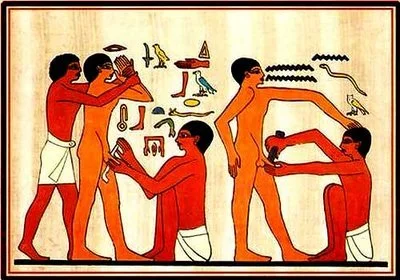
Relief from the Tomb of Ankhmahor ("Physician's Tomb"), Saqqara, Egypt. Old Kingdom, 6th Dynasty, reign of King Teti, c. 2345–2333 BCE.
ORIGINS
Circumcision in religious traditions
Before there were devices, there was technique, tradition, and accumulated experience.
For centuries, circumcision was preserved not only as a surgical act, but as a religious and cultural tradition. Artistic depictions of the circumcision of Jesus reflect how deeply the procedure became embedded in Western religious history.
The historical record reminds us that circumcision existed long before standardized medical devices—and that generations of practitioners developed methods to perform it with the tools available to them.
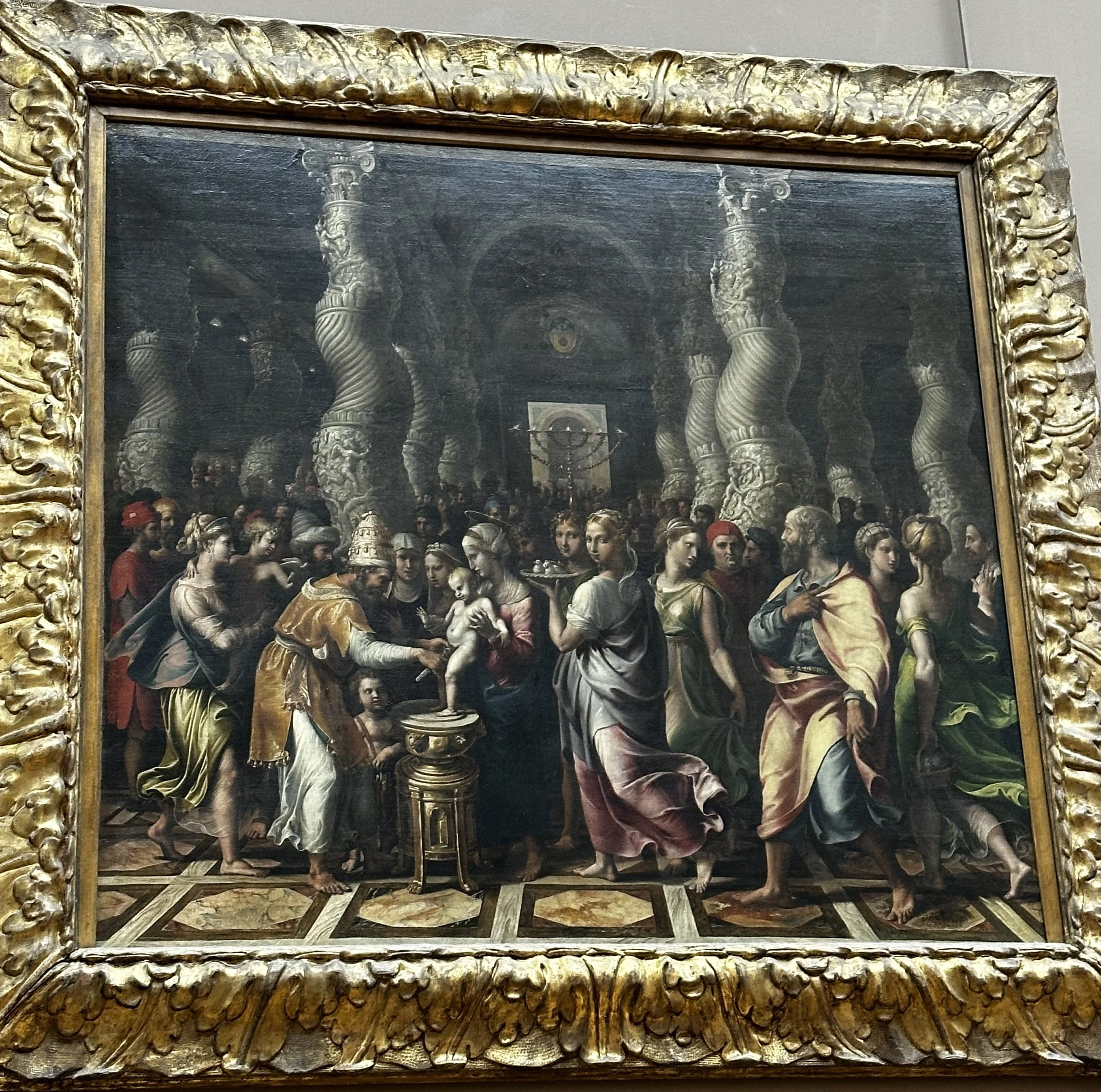
Giulio Romano (Giulio Pippi), The Circumcision, c. 1520–1524
EARLY INSTRUMENTS
The instruments of Brit Milah
Tradition. Protection.
Jewish ritual circumcision preserved a specialized instrument tradition over many centuries. Historical knives, shields, and related implements illustrate an early effort to standardize the procedure and separate the cutting instrument from structures intended to be protected.
These surviving instruments show two distinct roles: a protective shield (Magen) and a dedicated cutting instrument (Izmel). The Brit Milah is the covenant of circumcision. Mohel is the person trained to perform the brit milah.
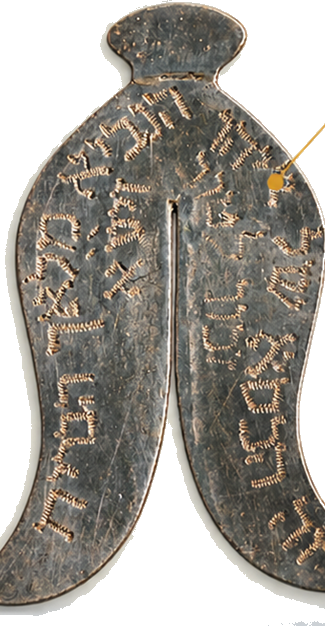
Magen
Protective Shield

Izmel
Protective Shield
Long before modern clamps, instrument design was already being used to shape technique. Photos courtesy of David Bolnick.
HIRAM S. YELLEN, B.S.
The bloodless clamp
A controlled clamp-assisted approach to circumcision.
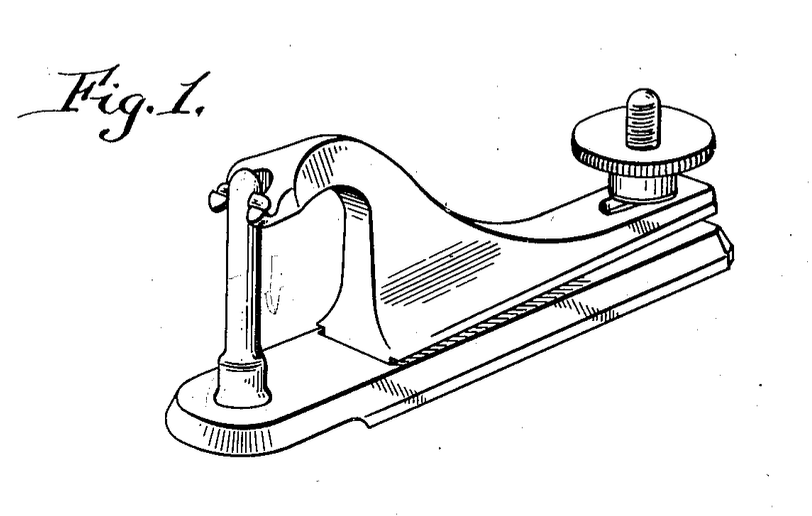
Yellen’s work introduced a bloodless circumcision clamp built around compression and hemostasis before excision. The concept became closely associated with the Gomco system and helped establish a new mechanical approach to the procedure.
1935 • Buffalo, New York
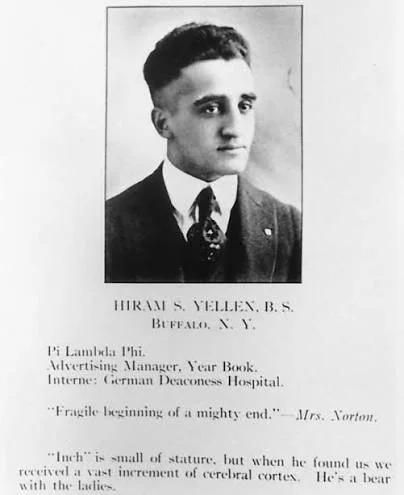
Source: Wan J. “GOMCO Circumcision Clamp: An Enduring and Unexpected Success.” Urology. 2002;59:790–794.
GOMCO CLAMP
Gomco: Engineering the bell and clamp
The Gomco separated the device into functional components: a bell to shield the glans, a platform, and a clamp mechanism to generate compression.
This modular architecture became highly recognizable, and the device preferred by most providers in the United States.
Design Limitation:
Interchangeable components can be mismatched, compromising glans protection.
Source: Stang HJ, Snellman LW. Circumcision practice patterns in the United States. Pediatrics. 1998;101(6):E5. doi:10.1542/peds.101.6.e5.
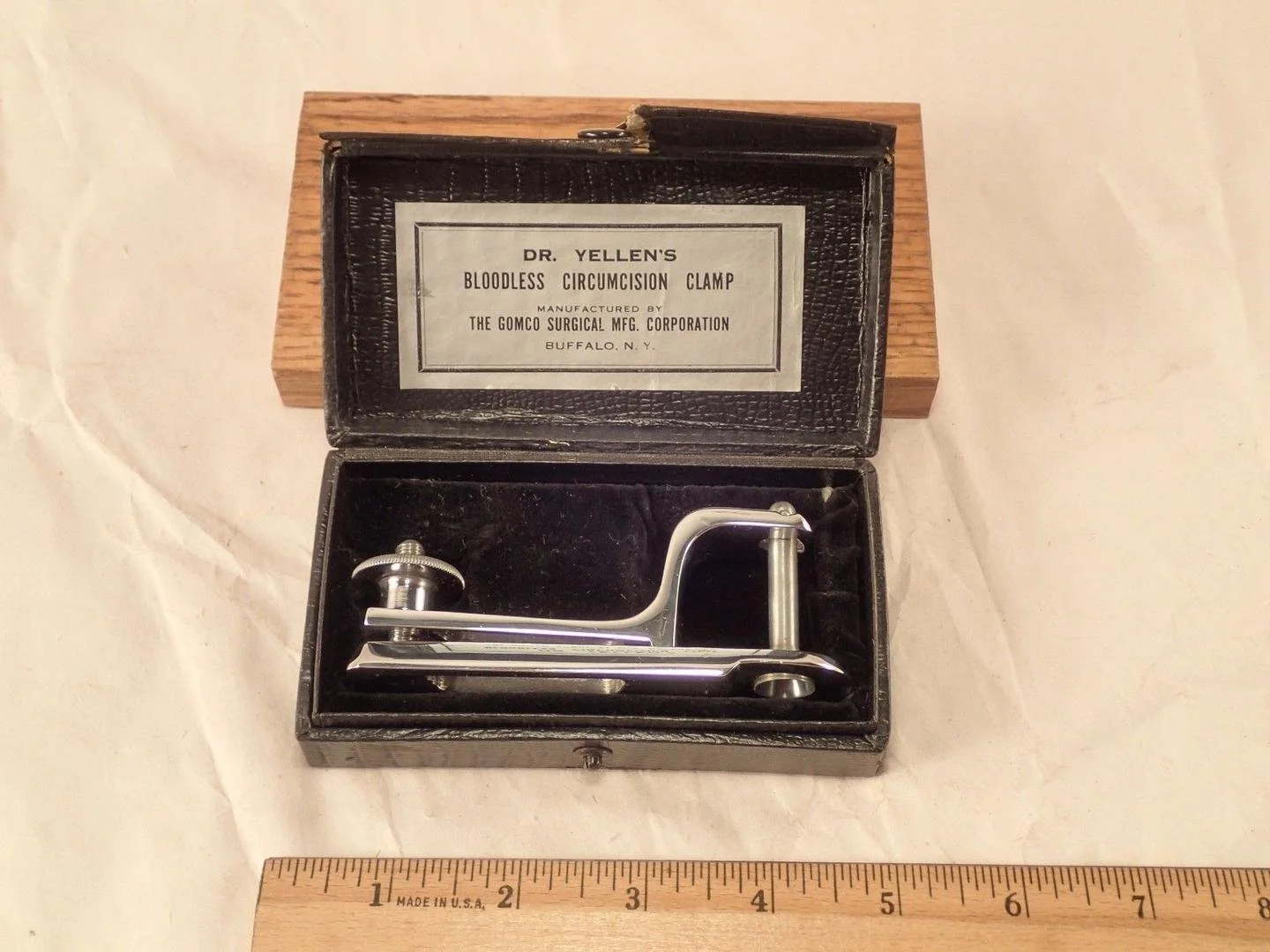
Dr. Yellen's Bloodless Circumcision Clamp, manufactured by the Gomco Surgical Mfg. Corporation, Buffalo, N.Y., c. 1930s–40s.
CECIL J. ROSS, M.D.
The circumcision ring
A different mechanical solution to protection, ligation, and excision.
1939 patent filing • Portland, Oregon
Ross developed a circumcision ring intended to protect underlying tissue while a ligature controlled the foreskin. His work represents an important branch in the evolution of ring-based circumcision devices.
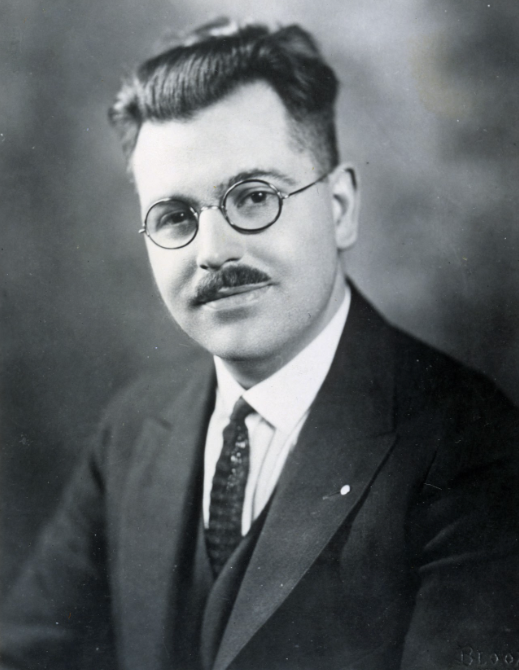
Source: Primary historical source: Columbia County Historical Society & Museum Association. Baker AG. Cecil J. Ross. Cecil Ross family history and archival materials, St. Helens, Oregon.
The Ross Ring marked a shift from mechanical clamping to a tourniquet principle. Instead of crushing the foreskin between clamp surfaces, a ligature tightened around the ring provided circumferential hemostasis while the ring protected the glans.
This concept anticipated the Plastibell, which refined the ring-and-ligature approach and became one of the most widely used circumcision devices in the United States.
Ross Ring: Introduction of a tourniquet technique
THE WIDER DEVICE FAMILY
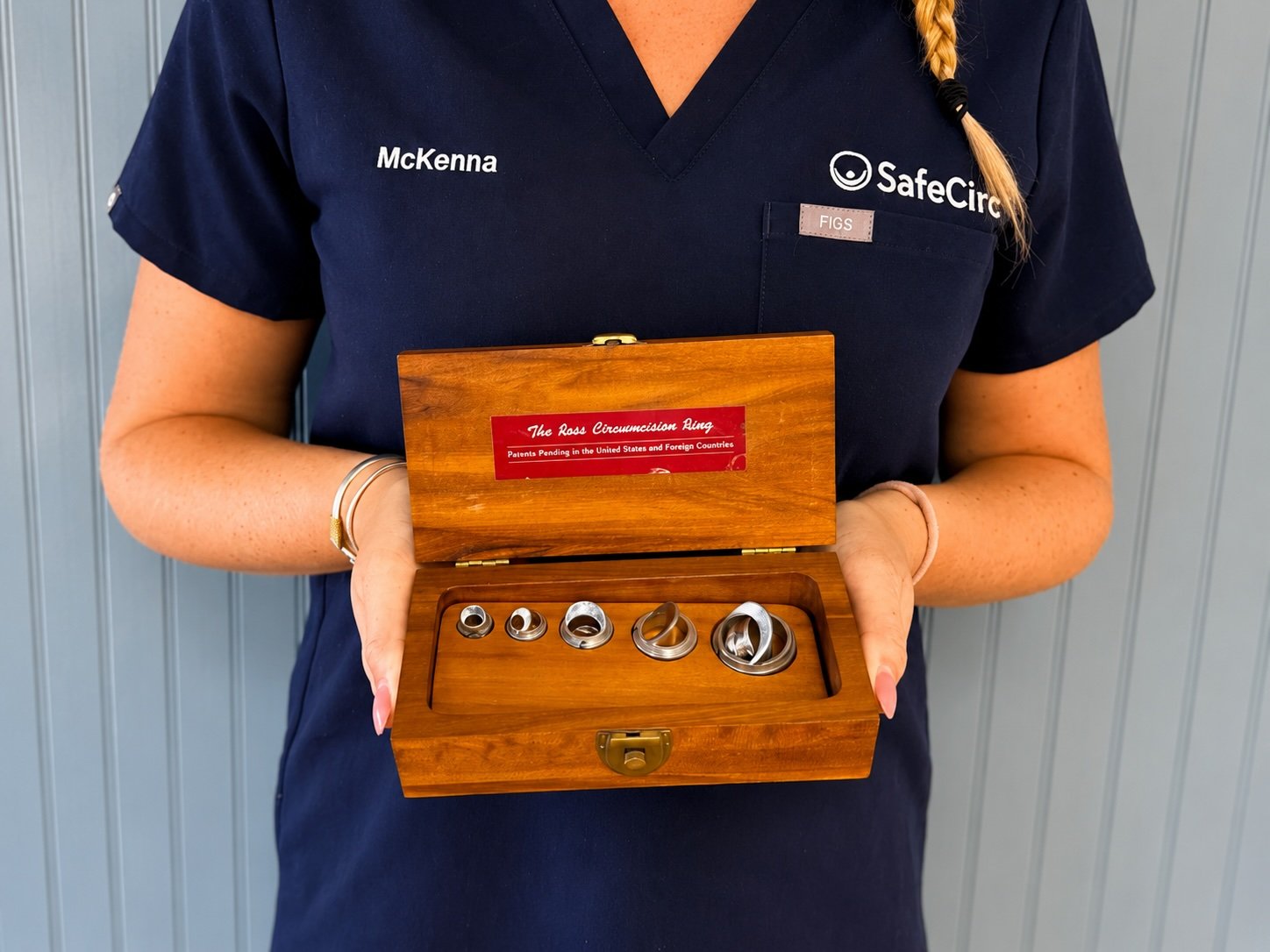
An Original Ross Circumcision Ring Set. Preserved by the Ross family and presented to Dr. David Tomlinson by the family of Dr. Cecil J. Ross.
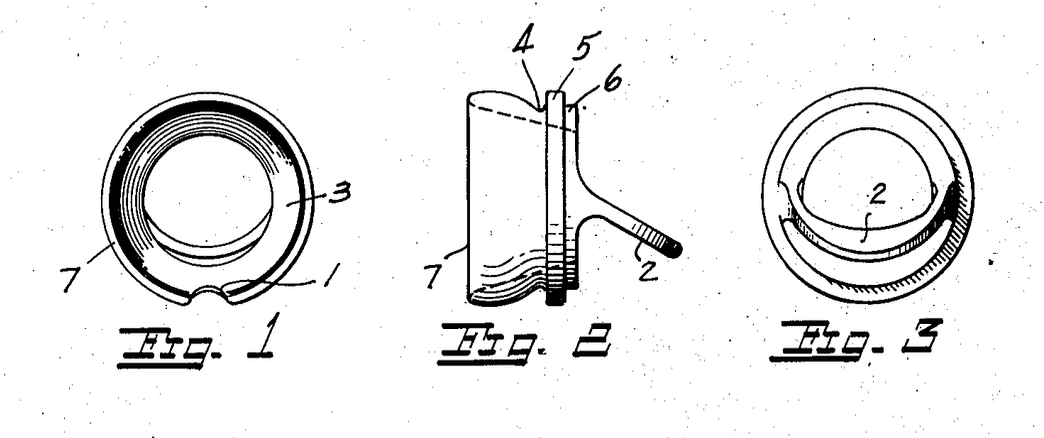
Kariher first described what would become the Plastibell, a bell-shaped hollow body with an annular ligature groove and a Y-shaped handle engineered to fracture and detach after the procedure.
Design Limitation
Tourniquet-style circumcision devices leave a constricting ring in place after the procedure. If the ring fails to separate as intended or becomes retained or displaced, prolonged constriction can cause progressive tissue injury. If not recognized and treated promptly, this can result in severe complications, including glans ischemia, necrosis, and, in rare cases, amputation.
From the Ross Ring to the PlastiBell
PLASTIBELL
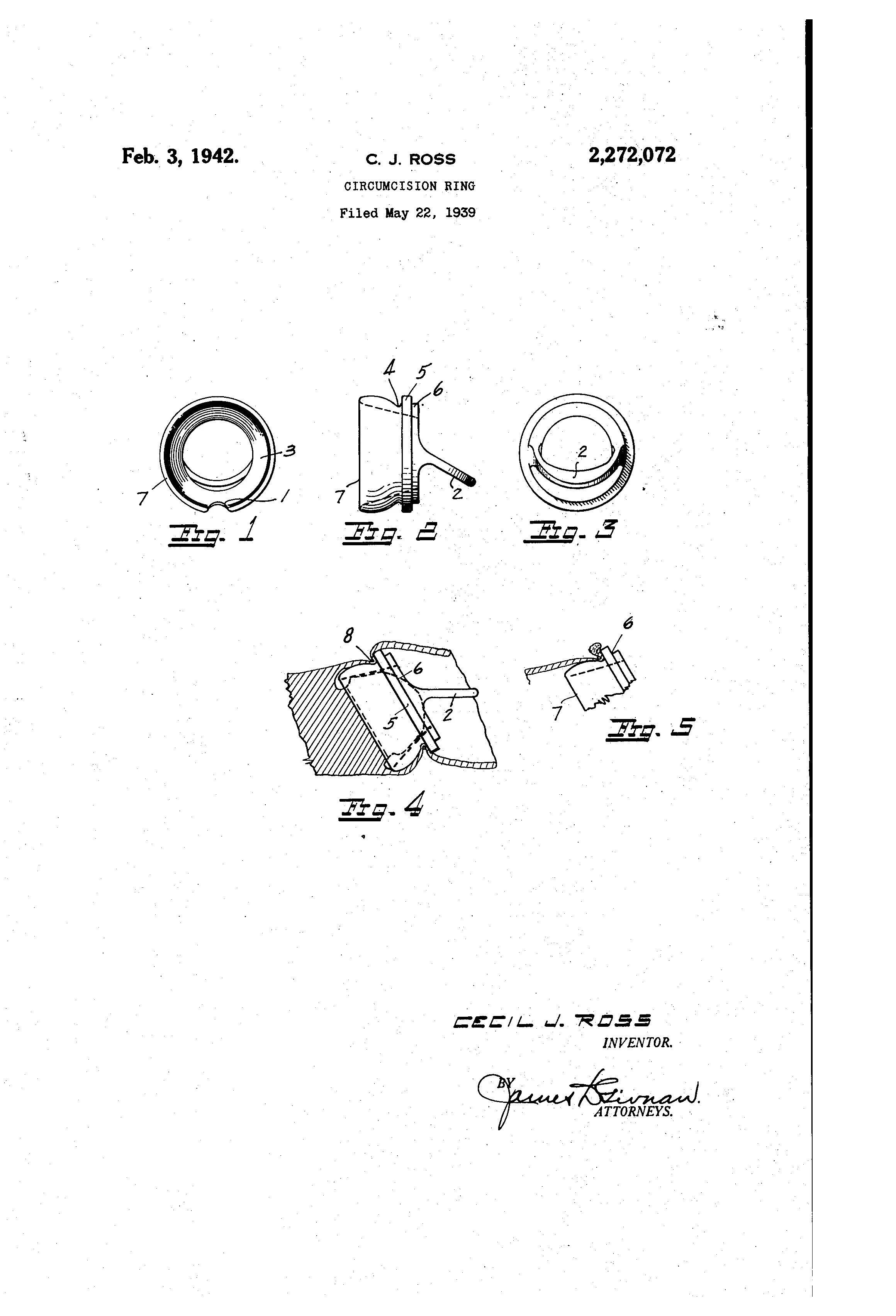
1939
ROSS
Metal circumcision ring
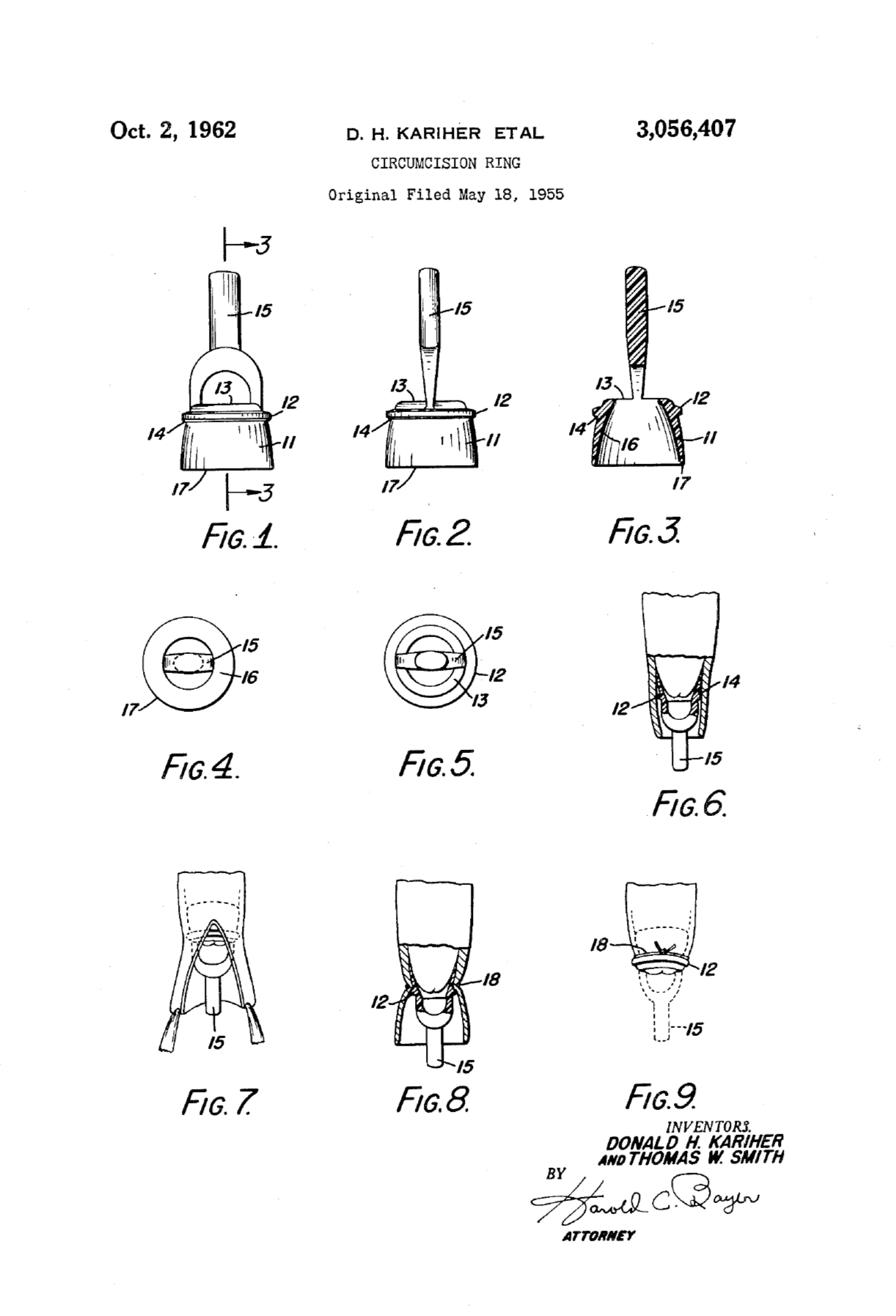
1962
KARIHER
Plastic ring with removable handle + ligature groove
Source: U.S. Patent and Trademark Office, U.S. Patent No. 2,272,072 and 3,056,407
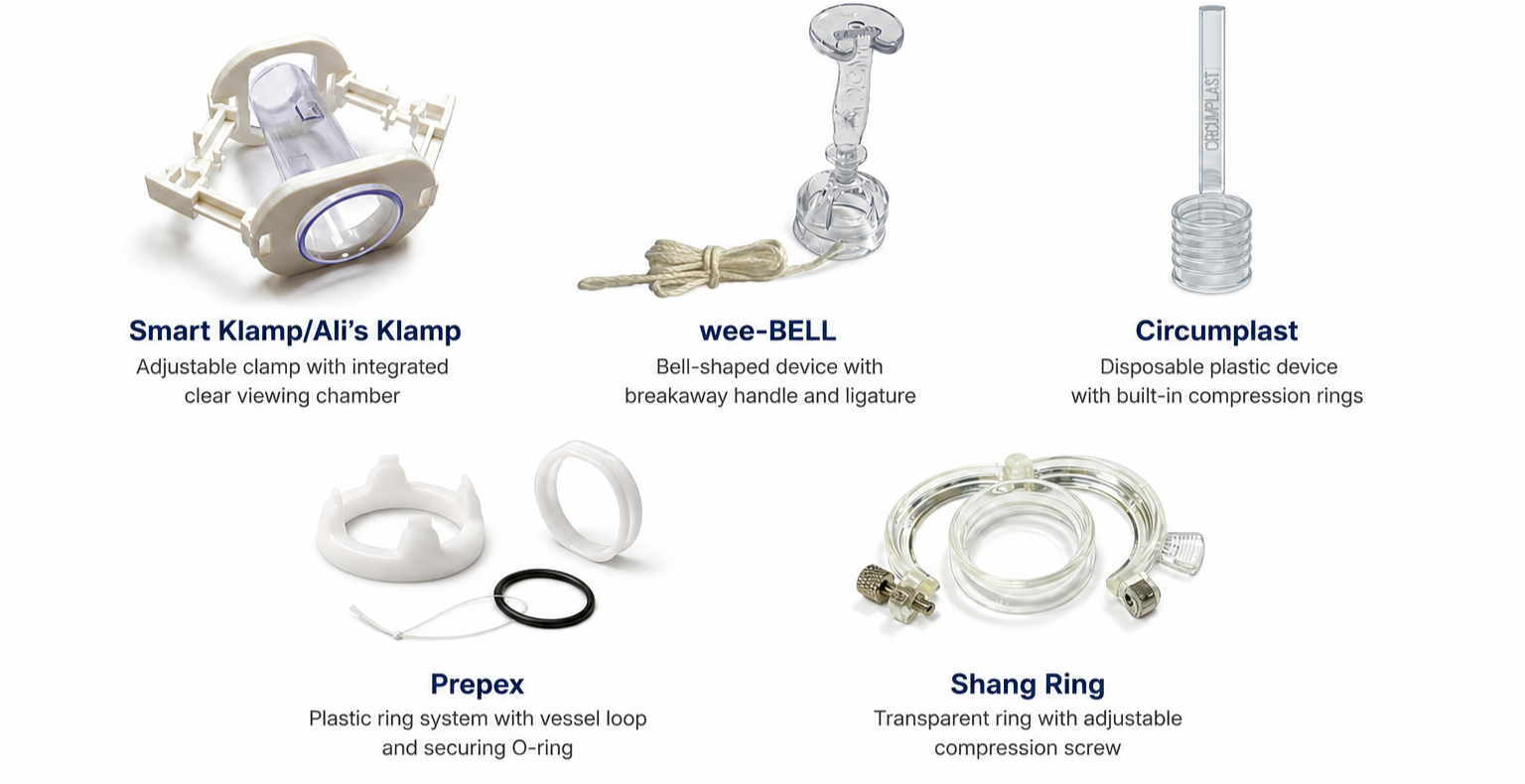
Other tourniquet-style devices
Despite variations in design, these devices share a common feature: a component remains on the penis during healing, introducing risks associated with retention, migration, or delayed separation.
HARRY BRONSTEIN
The Mogen clamp
Bridging ritual tradition and modern instrument design
PATENT ISSUED 1956 • BROOKLYN, NEW YORK • MOHEL • INVENTOR
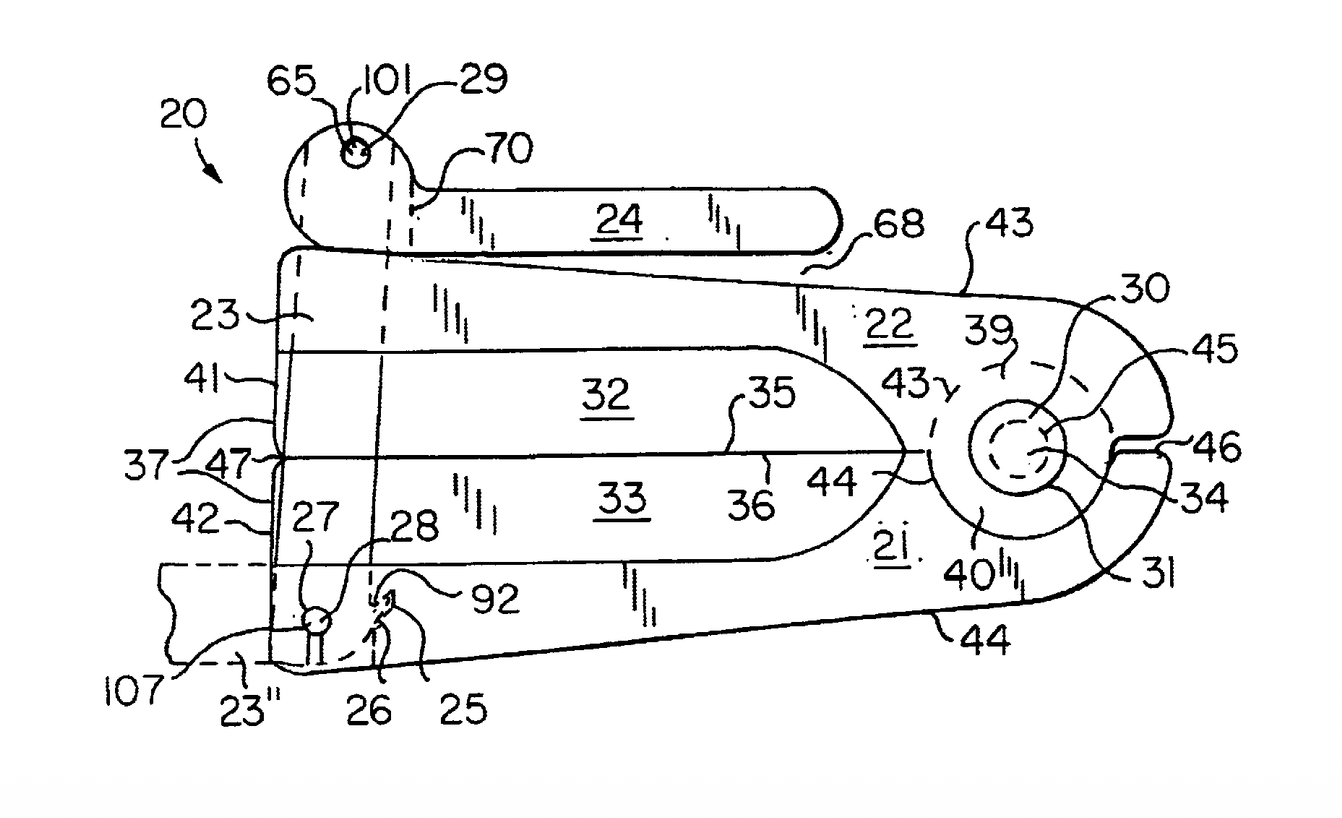
In the mid-1950s, Rabbi Harry Bronstein developed a clamp intended to make circumcision more controlled while remaining compatible with ritual practice.
The patent explicitly addresses compatibility with the Hebraic rite of circumcision.
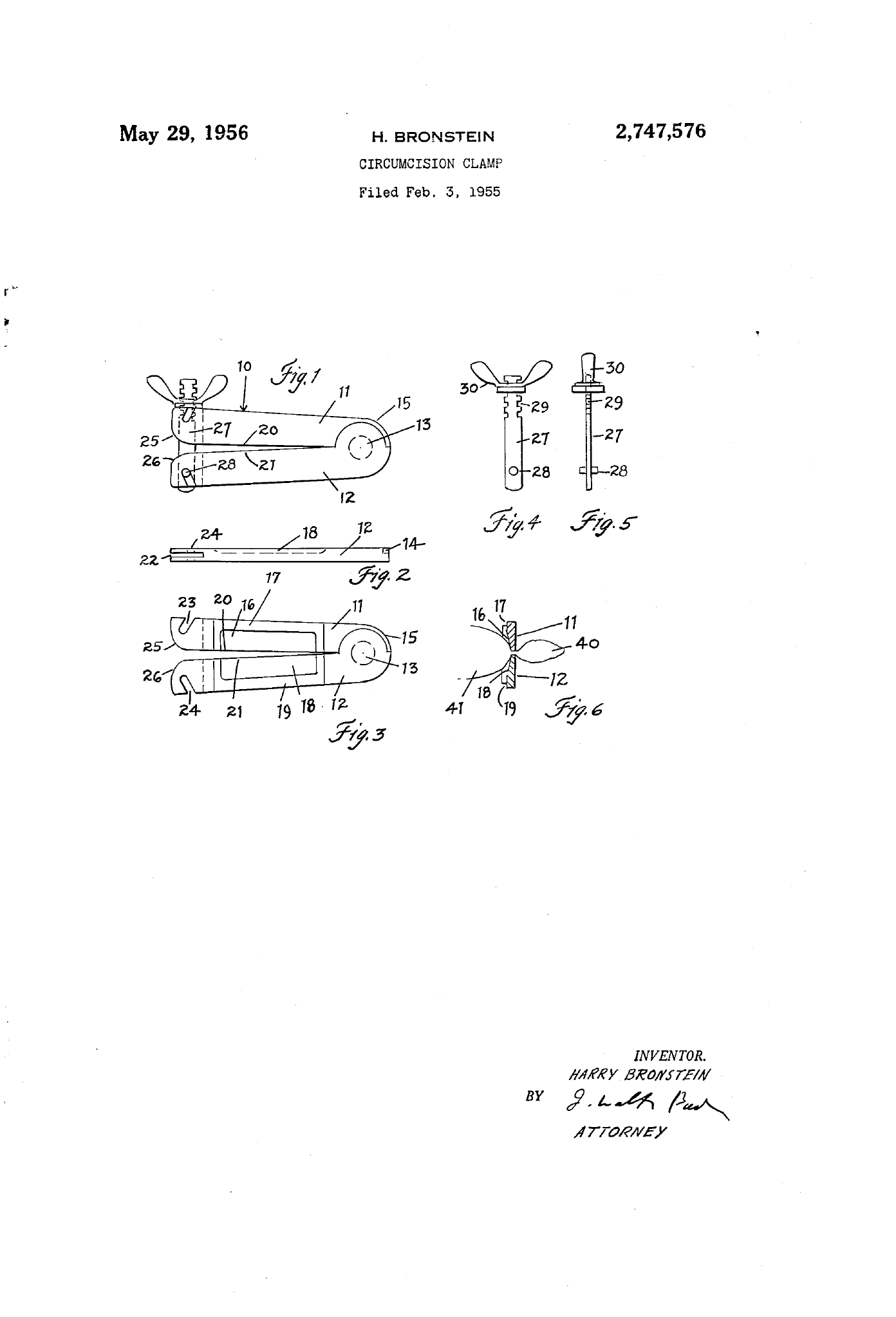
Sources: Bronstein H. Circumcision Clamp. U.S. Patent No. 2,747,576; issued May 29, 1956.
MID-CENTURY CLAMP DESIGN
Mogen clamp
The Mogen clamp became one of the best-known approaches to newborn circumcision. Its compact, shield-like clamp allowed the foreskin to be drawn forward and compressed before excision.
Its appeal was procedural simplicity: a small reusable instrument, rapid application, and direct compression for hemostasis.
Design Limitation
Unlike bell-based devices, the Mogen clamp does not place a protective barrier over the glans during foreskin excision. Because the glans is not directly visualized during the cutting step, improper positioning or entrapment can result in rare but serious glans injury, including partial or complete amputation.
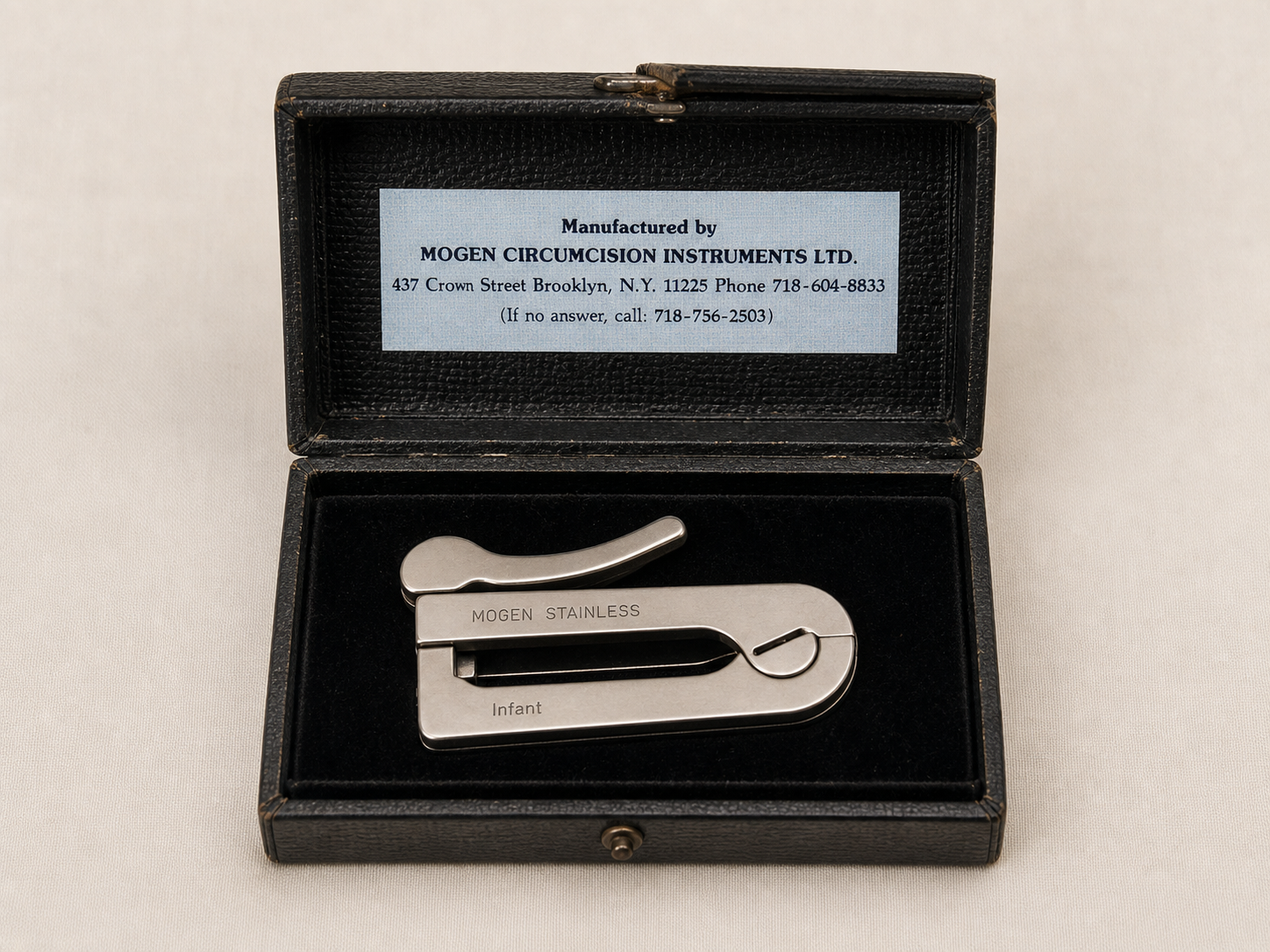
Photo of original Mogen clamp courtesy of David Bolnick
RAYMOND C. CREELMAN
The origins of the infant circumcision restraint
Stabilize the infant while preserving access to the operative field
1953 PATENT FILING
A design concept that endured for generations
A rigid molded receptacle supported the torso, arms, legs and head while limiting lateral movement.
Padded hold-down elements at the elbows and knees worked with the molded contours to immobilize the infant. The patent specifically identifies circumcision among the procedures for which the device was intended.
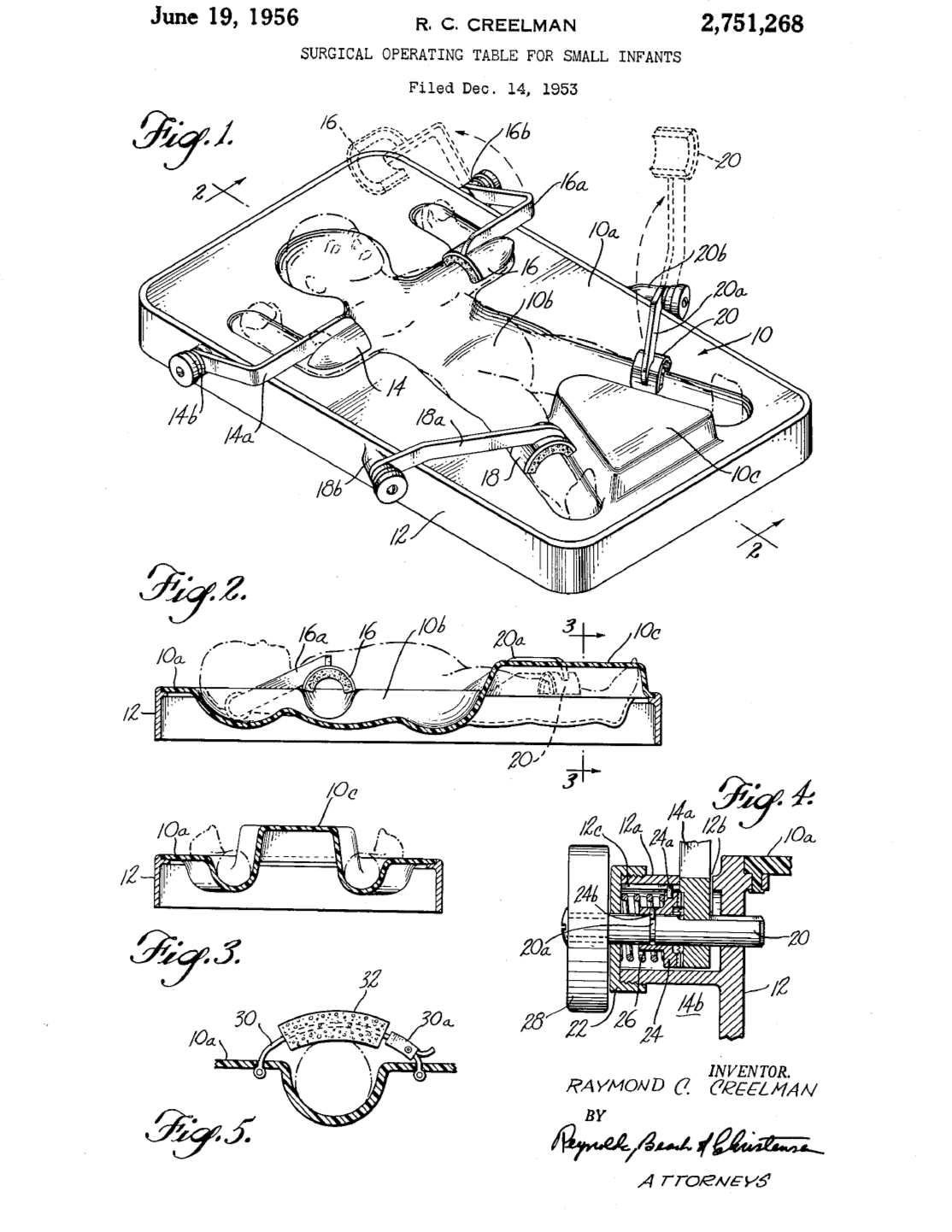
Source: U.S. Patent and Trademark Office, U.S. Patent No. 2,751,268

FROM DEVICE INNOVATION TO SYSTEM INNOVATION
Core device architecture hasn’t changed significantly for generations — until now.
We honor the original ideas. We studied their limitations. And we built the next generation of circumcision devices and methodologies deliberately.
DAVID R. TOMLINSON, M.D.
The AccuCirc®
While earlier devices demonstrated the value of compression, shielding, controlled tissue positioning, and procedural simplicity, their accumulated clinical experience also clarified where additional safeguards might be valuable.
AccuCirc® brought those lessons together in a system designed specifically around safety and accuracy. The AccuCirc® eliminates the need for a dorsal slit, prevents mismatching device parts, and incorporates a foreskin holder to accurately align the foreskin.
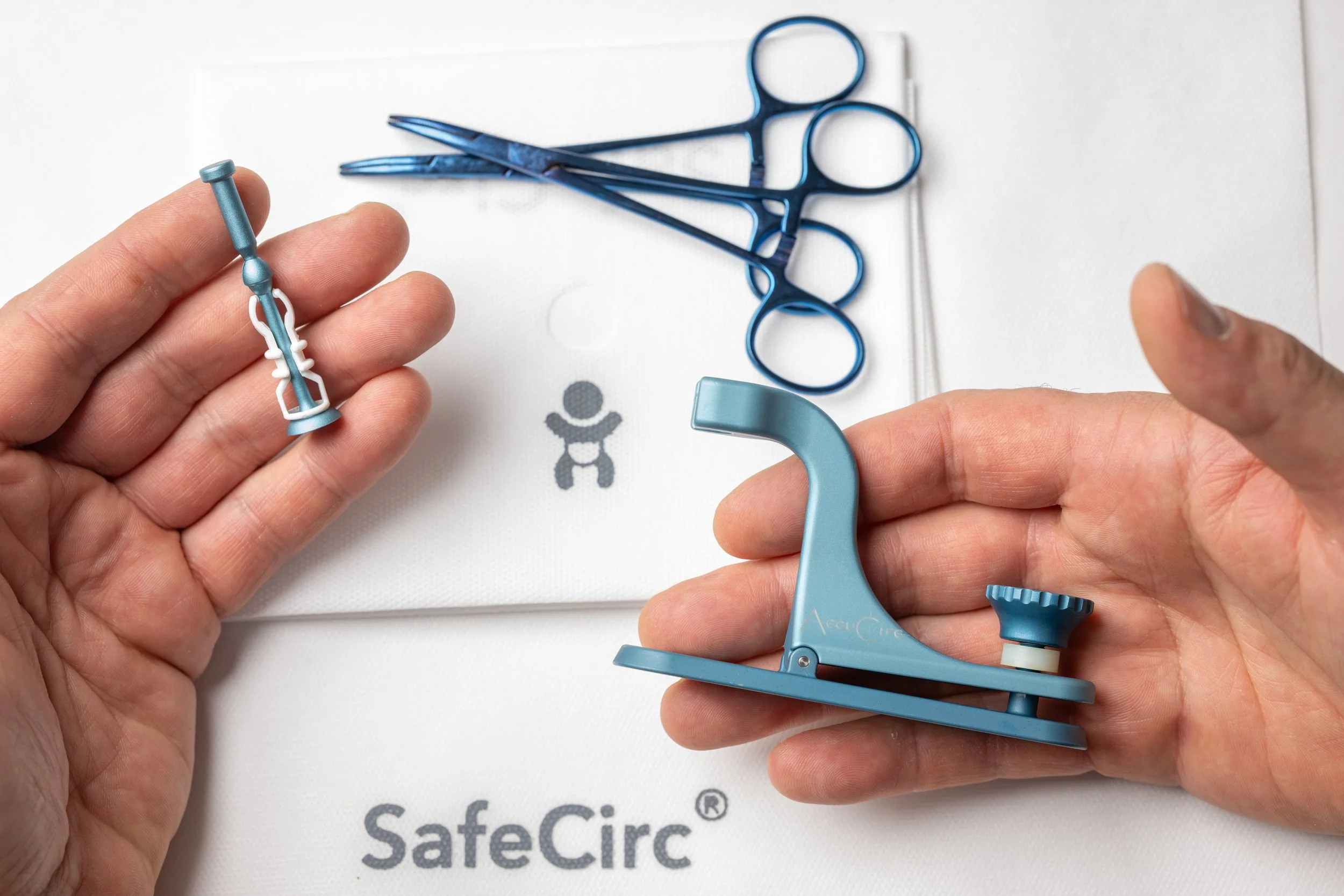
The proprietary Minimally Invasive AccuCirc®
DAVID R. TOMLINSON, M.D.
The SafeCirc® Newborn Positioning System
The Newborn Positioning System creates a stable, more comfortable, hygienic foundation that supports consistent, efficient care focused on newborn safety and comfort. Magnetic restraint points secure the positioning straps without slots or openings in the platform, creating a smooth, uninterrupted surface that is easier to prepare and clean.
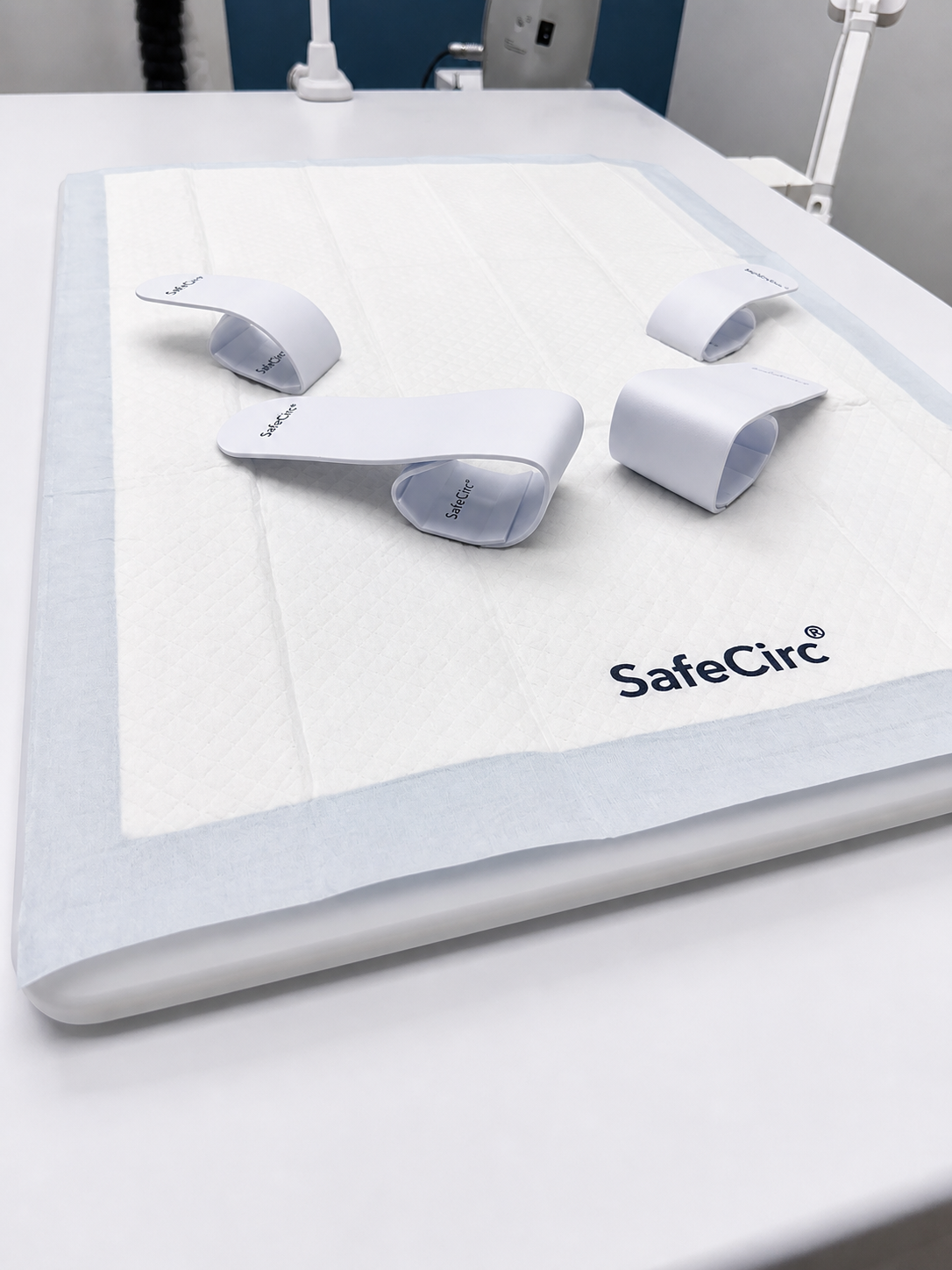
Designed around the newborn and the provider: Comfort, safety, and convenience

Each generation of circumcision devices represented an effort to solve practical clinical problems.
The designs, successes, limitations, and accumulated clinical experience of early innovators in this space shaped how today’s clinicians think about tissue control, glans protection, hemostasis, procedural consistency, and follow-up.
Today, SafeCirc® Institute carries that innovation forward to create a safer, more accurate care practice for providers and families alike.