

Vitamin K and Newborn Circumcision: Our Policy and Clinical Rationale
SafeCirc recommends intramuscular vitamin K at birth as the standard and most reliable protection against vitamin K deficiency bleeding. When families decline IM vitamin K, we encourage the use of an appropriate oral vitamin K regimen.
For families who decline both IM and oral prophylaxis, circumcision may still be considered in carefully selected infants only when the family provides informed consent, agrees to the emergency administration of IM vitamin K if clinically indicated for bleeding, and the procedure is performed within a structured protocol that includes individualized risk assessment, meticulous hemostasis, direct post-circumcision observation, and a clearly defined emergency response plan.
Evidence summary
Newborns have physiologically limited vitamin K stores, and vitamin K deficiency bleeding (VKDB) can present during the first week of life or later in infancy. Bleeding may occur from the circumcision site, gastrointestinal tract, umbilicus, or intracranially. A single intramuscular dose of vitamin K at birth is the most effective and reliable preventive strategy and remains the standard of care in the US.
The circumcision-specific evidence demonstrates a meaningful reduction in post-circumcision bleeding with vitamin K prophylaxis. A systematic review identified a substantial reduction in secondary bleeding after neonatal circumcision among infants who received intramuscular or oral vitamin K. This limited published evidence suggests that appropriately administered multidose oral vitamin K regimens provide protection against post-circumcision bleeding comparable to intramuscular vitamin K.
Oral vitamin K prophylaxis appears effective in preventing classic VKDB, the category that includes vitamin-K-deficiency bleeding after circumcision during the first week of life. It is therefore biologically reasonable to expect oral prophylaxis to reduce post-circumcision VKDB. However, equivalence to intramuscular vitamin K for preventing clinical post-circumcision bleeding has not been directly established.
The role of intramuscular vitamin K is not limited to prophylaxis. In a published case report by Plank et al., an infant who had not received prophylactic vitamin K experienced persistent bleeding for 90 minutes following circumcision. After intramuscular vitamin K was administered, the bleeding stopped within 30 minutes. The authors emphasized the rapid clinical effect of vitamin K in this setting. This experience supports maintaining immediate access to IM vitamin K as part of a contingency protocol for infants who develop persistent post-circumcision bleeding when prophylactic vitamin K has been declined or is unavailable.
“Current evidence supports a selective, protocol-based approach when prophylactic intramuscular vitamin K is declined:
“When appropriately counseled and with contingency protocols in place, circumcision may be safely performed in select infants without prophylactic IM vitamin K.¹”
Published clinical pathway
Tomlinson et al. — Reference 1
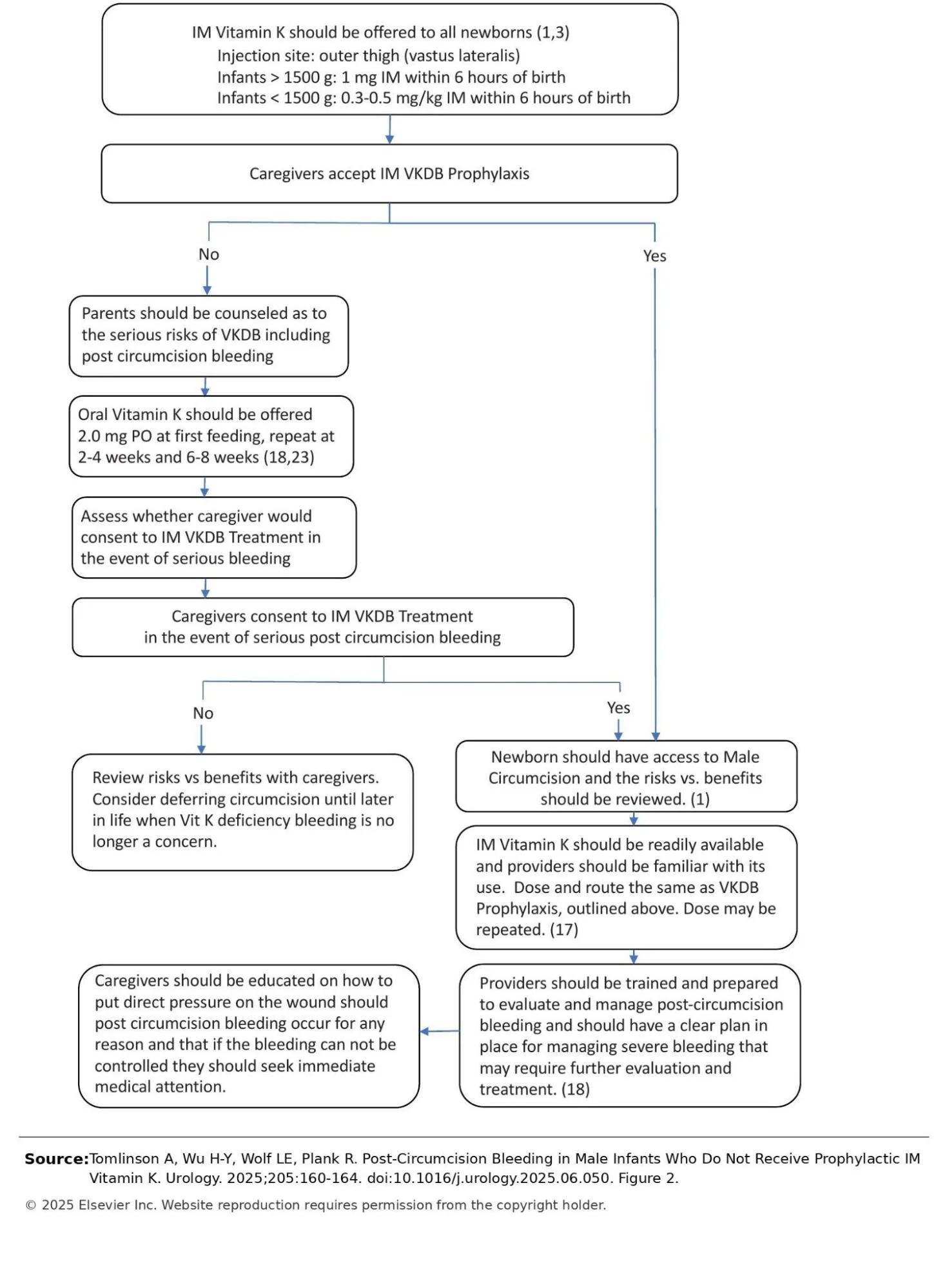
Published vitamin K and newborn male circumcision pathway. Reproduced from Tomlinson A, Wu H-Y, Wolf LE, Plank R. Reference 1 (published as Figure 2).
Why SafeCirc uses a structured policy
• IM vitamin K remains preferred. It provides the most dependable protection against both classic and late VKDB and should be strongly recommended to every family.
• If IM vitamin K is declined, families should be offered oral vitamin K. Oral vitamin K is less reliable than IM administration but appropriately administered multidose oral regimens can reduce the risk of classic and late VKDB and provide meaningful protection compared with no prophylaxis.
• Refusal changes the risk assessment. An infant who has not received IM vitamin K requires additional review and should not be considered equivalent to an infant who received standard prophylaxis.
• Risk is not determined by vitamin K status alone. Gestational age, clinical stability, feeding history, jaundice or possible cholestasis, maternal medications, family bleeding history, prior abnormal bleeding, and procedural factors may all materially affect eligibility.
• Technique and systems matter. At SafeCirc, we use a minimally invasive approach, thermal cautery and tissue adhesive all designed to reduce bleeding risk. We also maintain a comprehensive protocol for the evaluation and management of post-circumcision bleeding, including the potential emergency use of IM vitamin K when clinically indicated.
• Families require explicit counseling. Counseling is essential so that parents can make informed decisions. If IM vitamin K is declined, families should be counseled regarding the relative risks and benefits and offered an alternative prophylaxis strategy.
Provider summary
IM vitamin K at birth remains the safest and preferred standard. SafeCirc applies a structured, risk-based framework: counsel clearly, select carefully, use reliable hemostatic technique, observe directly, and maintain an immediate contingency plan for bleeding.
References
1. Tomlinson A, Wu H-Y, Wolf LE, Plank R. Post-Circumcision Bleeding in Male Infants Who Do Not Receive Prophylactic IM Vitamin K. Urology. 2025;205:160-164. doi:10.1016/j.urology.2025.06.050.
2. Hand I, Noble L, Abrams SA; American Academy of Pediatrics Committee on Fetus and Newborn, Section on Breastfeeding, and Committee on Nutrition. Vitamin K and the Newborn Infant. Pediatrics. 2022;149(3):e2021056036. doi:10.1542/peds.2021-056036.
3. Sankar MJ, Chandrasekaran A, Kumar P, Thukral A, Agarwal R, Paul VK. Vitamin K prophylaxis for prevention of vitamin K deficiency bleeding: a systematic review. J Perinatol. 2016;36(Suppl 1):S29-S35. doi:10.1038/jp.2016.30.
4. Plank RM, Steinmetz T, Sokal DC, Shearer MJ, Data S. Vitamin K Deficiency Bleeding and Early Infant Male Circumcision in Africa. Obstet Gynecol. 2013;122(2 Pt 2):503-505. doi:10.1097/AOG.0b013e31828b2f5c.
5. Mendelson JL, Jacobs A, Alvarez Vega D, et al. Neonatal circumcisions and parental refusal of intramuscular vitamin K: A review of the literature and current guidelines. J Pediatr Urol. 2025. doi:10.1016/j.jpurol.2024.12.014.
6. Blank S, Brady M, Buerk E, et al. Male circumcision. Pediatrics. 2012;130(3):e756-e785. doi:10.1542/peds.2012-1990.
7. Loyal J, Shapiro ED. Refusal of Intramuscular Vitamin K by Parents of Newborns: A Review. Hosp Pediatr. 2020;10(3):286-294. doi:10.1542/hpeds.2019-0228.
8. Mihatsch WA, Braegger C, Bronsky J, et al. Prevention of Vitamin K Deficiency Bleeding in Newborn Infants: A Position Paper by the ESPGHAN Committee on Nutrition. J Pediatr Gastroenterol Nutr. 2016;63(1):123-129. doi:10.1097/MPG.0000000000001232.
9. Vietti TJ, Murphy TP, James JA, Pritchard JA. Observations on the prophylactic use of vitamin K in the newborn infant. J Pediatr. 1960;56:343-346.
10. Loyal J, Taylor JA, Phillipi CA, et al. Factors Associated With Refusal of Intramuscular Vitamin K in Normal Newborns. Pediatrics. 2018;142(2):e20173743. doi:10.1542/peds.2017-3743.